


Projekt Paměť - Vracíme lidskou důstojnost
- Podrobnosti
- Aktualizováno: 28. 3. 2026 17:47
- Zveřejněno: 22. 3. 2026 19:21
- Napsal Jiří Honza
Kdo byli muži z chotovinského hřbitova?
Karel van Coevorden (vězeň č. 172662)
Friedrich Noteles (vězeň č. 175260)
Salomon Scharf (vězeň č. A-18941)
Příběh těchto tří mužů je připomínkou, že historie nemusí být jen v učebnicích, ale vyprávějí ji konkrétní lidské životy, které shodou okolností vyhasly v naší těsné blízkosti. Tím, že jsme k číslům 172662, 175260 a A-18941 přiřadili jména Karel, Friedrich a Salomon, jsme splatili dluh minulosti.
„Vrátit jméno mrtvému znamená vrátit mu jeho důstojnost.“
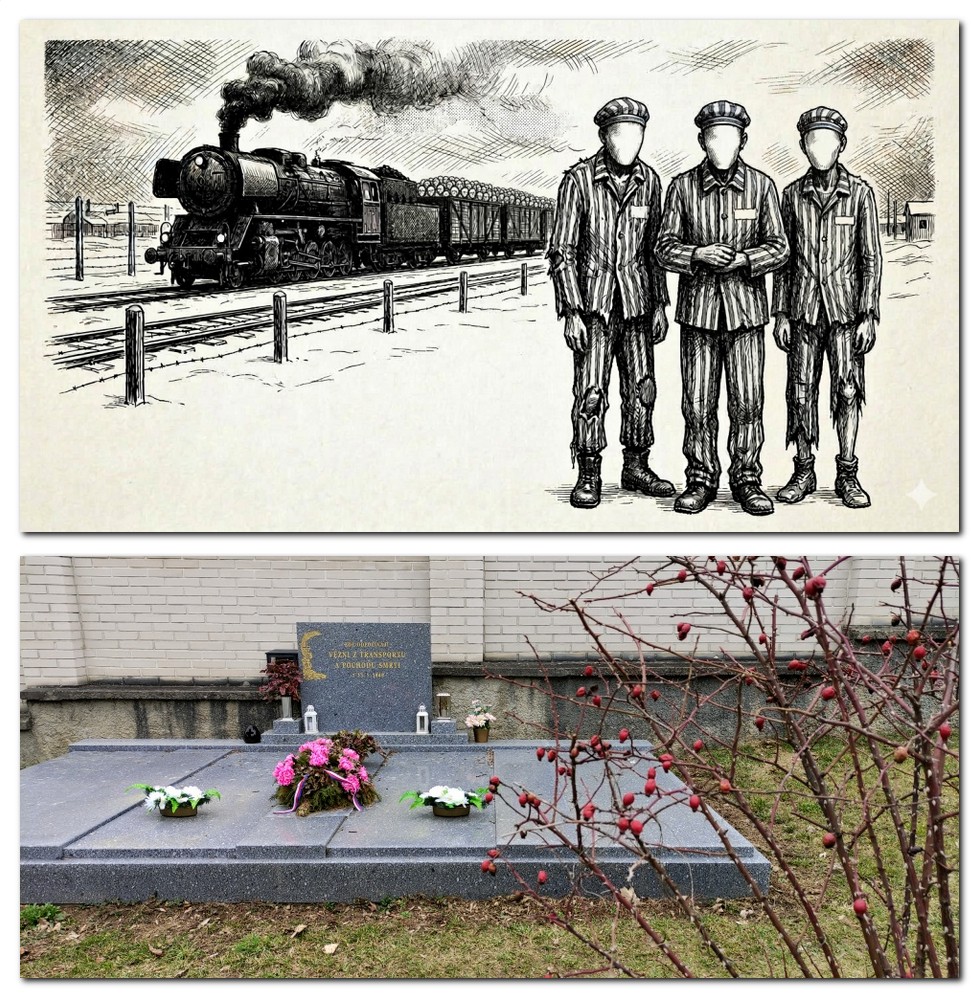
Tento výzkum vznikl v rámci školního projektu Paměť zaměřeného na regionální historii a holocaust. Díky možnostem AI, jejím schopnostem zobrazovat nereálný svět (ilustrační kresba) a digitalizaci části archivů jsme mohli po osmnácti letech náš projekt ukončit. Podklady byly čerpány z archivu Arolsen Archives, památníku Yad Vashem a dobových svědectví členů Českého svazu protifašistických bojovníků a očitého svědka události pana Petra Pekárka.
Péče o hroby
Project Memory — Restoring Human Dignity
On January 13, 1945, at 3:40 PM, a death train passed through Chotoviny station. The temperature that day plummeted to twenty degrees below zero. From open coal wagons, where hundreds of prisoners from Auschwitz were huddled in the freezing cold, three lifeless bodies were cast onto the tracks. Local citizens buried these men with honor in the Chotoviny cemetery. For eighty long years, we were never certain who slept this eternal sleep among our own loved ones. We did not know who loved them, who mourned them, who missed them, or who — until now — could not find the place of their final rest.
Our school project, with the help of AI, has broken the silence of the numbers. Thanks to archival research and collaboration with historical databases, we can today, for the first time since the end of the war, return a human face to these three individuals with certainty.
Who were the men of the Chotoviny cemetery?
Through the registration numbers on their prison uniforms, these specific fates were identified:
- Karel van Coevorden (Prisoner No. 172662)
A young Dutchman who was only 22 years old at the time of his death near Chotoviny. Hailing from Amsterdam, he was a beloved son whose mother kept a touching diary of his childhood, which is preserved in an Amsterdam museum to this day. He survived a year in Auschwitz, but his body could no longer endure the cruel transport through South Bohemia. - Friedrich Noteles (Prisoner No. 175260)
A native of Vienna who fled to the Netherlands to escape the Nazis. He was 44 years old. Along with Karel, he was deported from the Westerbork transit camp in February 1944. Before the war, he was a man in his prime who hoped to find a new home in the safety of the Netherlands. The January frost in an open wagon on the line between Tábor and Prague proved fatal for him. - Salomon Scharf (Prisoner No. A-18941)
His identity was only revealed today, eighteen years after the start of our Project Memory. A thirty-one-year-old locksmith from Dębica, Poland. His number, beginning with the letter "A," tells the story of a man brought to Auschwitz in August 1944. His wife, Fryda, waited for him in vain. Only a few months of the war remained when his life ended at the 92nd kilometer of the railway track within our village limits.
The story of these three men serves as a reminder that history is not just found in textbooks; it is told through specific human lives that, by chance, were extinguished in our immediate vicinity. By assigning the names Karel, Friedrich, and Salomon to numbers 172662, 175260, and A-18941, we have repaid a debt to the past.
"To return a name to the dead is to return their dignity."
About the Project
This research was created as part of the school project Memory, focusing on regional history and the Holocaust. Thanks to the possibilities of AI and the digitization of archives, we were able to conclude our project after eighteen years. Sources were drawn from the Arolsen Archives, the Yad Vashem memorial, historical testimonies from members of the Czech Union of Freedom Fighters, and eyewitness accounts from Mr. Petr Pekárek.
Care for the Graves
Following partial adjustments in previous years to facilitate maintenance, the municipality of Chotoviny ensured a general renovation of this memorial site in 2025. This created a dignified final resting place for the victims of the death transport and a permanent reminder, carved in stone, of the atrocities of National Socialism. It must be emphasized that all wars — including those happening today — bring with them similar horrors and injustices. Memory loss and human indifference contribute significantly to them. Therefore, we do not forget, and we refuse to be indifferent to human suffering.
Projekt Memory — Wiederherstellung der menschlichen Würde
Am 13. Januar 1945 um 15:40 Uhr passierte ein Todeszug den Bahnhof Chotoviny. Die Temperatur sank an diesem Tag auf zwanzig Grad unter Null. Aus offenen Kohlewaggons, in denen hunderte Häftlinge aus Auschwitz in der eisigen Kälte kauerten, wurden drei leblose Körper auf die Gleise geworfen. Örtliche Bürger bestatteten diese Männer ehrenvoll auf dem Friedhof von Chotoviny. Achtzig lange Jahre lang wussten wir nicht sicher, wer diesen ewigen Schlaf inmitten unserer eigenen Angehörigen schlief. Wir wussten nicht, wer sie geliebt hat, wer um sie trauerte, wer sie vermisste oder wer — bis heute — den Ort ihrer letzten Ruhe nicht finden konnte.
Unser Schulprojekt hat mit Hilfe von KI das Schweigen der Nummern gebrochen. Dank Archivrecherchen und der Zusammenarbeit mit historischen Datenbanken können wir heute, zum ersten Mal seit Kriegsende, diesen drei Individuen mit Gewissheit ein menschliches Gesicht zurückgeben.
Wer waren die Männer vom Friedhof in Chotoviny?
Durch die Registriernummern auf ihrer Häftlingskleidung konnten diese spezifischen Schicksale identifiziert werden:
- Karel van Coevorden (Häftling Nr. 172662)
- Ein junger Niederländer, der zum Zeitpunkt seines Todes bei Chotoviny erst 22 Jahre alt war. Er stammte aus Amsterdam und war ein geliebter Sohn, dessen Mutter ein berührendes Tagebuch über seine Kindheit führte, das bis heute in einem Amsterdamer Museum aufbewahrt wird. Er überlebte ein Jahr in Auschwitz, doch sein Körper hielt den grausamen Transport durch Südböhmen nicht mehr stand.
- Friedrich Noteles (Häftling Nr. 175260)
- Ein gebürtiger Wiener, der in die Niederlande floh, um den Nationalsozialisten zu entkommen. Er war 44 Jahre alt. Zusammen mit Karel wurde er im Februar 1944 aus dem Durchgangslager Westerbork deportiert. Vor dem Krieg war er ein Mann in den besten Jahren, der hoffte, in der Sicherheit der Niederlande ein neues Zuhause zu finden. Der Januarfrost in einem offenen Waggon auf der Strecke zwischen Tábor und Prag wurde ihm zum Verhängnis.
- Salomon Scharf (Häftling Nr. A-18941)
- Seine Identität wurde erst heute enthüllt, achtzehn Jahre nach Beginn unseres Projekts Memory. Ein einunddreißigjähriger Schlosser aus Dębica, Polen. Seine Nummer, die mit dem Buchstaben „A“ beginnt, erzählt die Geschichte eines Mannes, der im August 1944 nach Auschwitz gebracht wurde. Seine Frau Fryda wartete vergeblich auf ihn. Es verblieben nur noch wenige Kriegsmonate, als sein Leben am 92. Kilometer der Bahnstrecke innerhalb unserer Gemeindegrenzen endete.
Die Geschichte dieser drei Männer erinnert uns daran, dass Geschichte nicht nur in Lehrbüchern zu finden ist; sie erzählt sich durch konkrete Menschenleben, die zufällig in unserer unmittelbaren Nähe ausgelöscht wurden. Indem wir den Nummern 172662, 175260 und A-18941 die Namen Karel, Friedrich und Salomon zugeordnet haben, haben wir eine Schuld gegenüber der Vergangenheit beglichen.
„Den Toten ihren Namen zurückzugeben, bedeutet, ihnen ihre Würde zurückzugeben.“
Über das Projekt
Diese Forschungsarbeit entstand im Rahmen des Schulprojekts Memory, das sich auf die Regionalgeschichte und den Holocaust konzentriert. Dank der Möglichkeiten der KI und der Digitalisierung von Archiven konnten wir unser Projekt nach achtzehn Jahren abschließen. Als Quellen dienten die Arolsen Archives, die Gedenkstätte Yad Vashem, historische Zeugnisse von Mitgliedern des Tschechischen Verbandes der Freiheitskämpfer und Augenzeugenberichte von Herrn Petr Pekárek.
Pflege der Gräber
Nach teilweisen Anpassungen in den Vorjahren zur Erleichterung der Pflege hat die Gemeinde Chotoviny im Jahr 2025 eine Generalsanierung dieser Gedenkstätte sichergestellt. Damit wurde eine würdige letzte Ruhestätte für die Opfer des Todestransports geschaffen und eine in Stein gemeißelte, dauerhafte Mahnung an die Gräueltaten des Nationalsozialismus gesetzt. Es muss betont werden, dass alle Kriege — auch die heutigen — ähnliche Schrecken und Ungerechtigkeiten mit sich bringen. Gedächtnisverlust und menschliche Gleichgültigkeit tragen wesentlich dazu bei. Deshalb vergessen wir nicht und weigern uns, menschlichem Leid gegenüber gleichgültig zu sein.
Projekt Memory — Przywracanie ludzkiej godności
13 stycznia 1945 roku o godzinie 15:40 przez stację Chotoviny przejechał pociąg śmierci. Temperatura tego dnia spadła do dwudziestu stopni poniżej zera. Z otwartych wagonów węglowych, w których w przeraźliwym mrozie tłoczyły się setki więźniów z Auschwitz, wyrzucono na tory trzy bezwładne ciała. Miejscowi obywatele z honorami pochowali tych mężczyzn na cmentarzu w Chotovinach. Przez osiemdziesiąt długich lat nie mieliśmy pewności, kto śpi tym wiecznym snem obok naszych bliskich. Nie wiedzieliśmy, kto ich kochał, kto po nich płakał, komu ich brakowało i kto — aż do teraz — nie mógł odnaleźć miejsca ich ostatecznego spoczynku.
Nasz projekt szkolny, z pomocą sztucznej inteligencji, przerwał milczenie numerów. Dzięki badaniom archiwalnym i współpracy z historycznymi bazami danych możemy dziś, po raz pierwszy od zakończenia wojny, z całą pewnością przywrócić ludzką twarz tym trzem osobom.
Kim byli mężczyźni z cmentarza w Chotovinach?
Dzięki numerom rejestracyjnym na pasiakach zidentyfikowano konkretne losy:
- Karel van Coevorden (Więzień nr 172662)
- Młody Holender, który w chwili śmierci w pobliżu Chotovin miał zaledwie 22 lata. Pochodził z Amsterdamu, był ukochanym synem, którego matka prowadziła wzruszający dziennik z jego dzieciństwa – jest on do dziś przechowywany w jednym z amsterdamskich muzeów. Przeżył rok w Auschwitz, ale jego organizm nie wytrzymał okrutnego transportu przez południowe Czechy.
- Friedrich Noteles (Więzień nr 175260)
- Rodowity wiedeńczyk, który uciekł do Holandii przed nazistami. Miał 44 lata. Razem z Karelem został deportowany z obozu przejściowego Westerbork w lutym 1944 roku. Przed wojną był mężczyzną w sile wieku, który miał nadzieję znaleźć nowy dom w bezpiecznej Holandii. Styczniowy mróz w otwartym wagonie na trasie między Taborem a Pragą okazał się dla niego śmiertelny.
- Salomon Scharf (Więzień nr A-18941)
- Jego tożsamość została ujawniona dopiero dzisiaj, osiemnaście lat po rozpoczęciu naszego Projektu Memory. Trzydziestojednoletni ślusarz z Dębicy w Polsce. Jego numer, zaczynający się od litery „A”, opowiada historię człowieka przywiezionego do Auschwitz w sierpniu 1944 roku. Jego żona, Fryda, czekała na niego na próżno. Do końca wojny pozostało tylko kilka miesięcy, gdy jego życie dobiegło końca na 92. kilometrze torów kolejowych w granicach naszej gminy.
Historia tych trzech mężczyzn przypomina, że historii nie odnajduje się tylko w podręcznikach; opowiadają ją konkretne ludzkie losy, które przypadkiem zgasły w naszym najbliższym sąsiedztwie. Przypisując nazwiska Karel, Friedrich i Salomon do numerów 172662, 175260 i A-18941, spłaciliśmy dług wobec przeszłości.
„Przywrócić zmarłym imię to przywrócić im godność”.
O projekcie
Badania te powstały w ramach szkolnego projektu Memory, skupiającego się na historii regionalnej i Holokauście. Dzięki możliwościom AI i digitalizacji archiwów, po osiemnastu latach mogliśmy zakończyć nasze prace. Korzystano z zasobów Arolsen Archives, instytutu Yad Vashem, świadectw historycznych członków Czeskiego Związku Bojowników o Wolność oraz relacji naocznego świadka, pana Petra Pekárka.
Opieka nad grobami
Po częściowych modyfikacjach w ubiegłych latach, mających na celu ułatwienie pielęgnacji, gmina Chotoviny zapewniła generalną renowację tego miejsca pamięci w 2025 roku. Stworzono godne miejsce spoczynku dla ofiar transportu śmierci oraz trwałe, wykute w kamieniu przypomnienie o okrucieństwach narodowego socjalizmu. Należy podkreślić, że wszystkie wojny — również te toczące się dzisiaj — niosą ze sobą podobne horrory i niesprawiedliwość. Brak pamięci i ludzka obojętność znacząco się do nich przyczyniają. Dlatego nie zapominamy i odmawiamy bycia obojętnymi na ludzkie cierpienie.
Project Memory — Herstel van Menselijke Waardigheid
Op 13 januari 1945 om 15:40 uur passeerde een dodentrein het station van Chotoviny. De temperatuur was die dag gedaald tot twintig graden onder nul. Uit open kolenwagons, waarin honderden gevangenen uit Auschwitz in de vrieskou opeengepakt zaten, werden drie levenloze lichamen op het spoor geworpen. Plaatselijke burgers hebben deze mannen met eer begraven op de begraafplaats van Chotoviny. Tachtig lange jaren wisten we niet zeker wie deze eeuwige slaap sliep te midden van onze eigen dierbaren. We wisten niet wie hen liefhad, wie om hen rouwde, wie hen miste of wie — tot nu toe — de plek van hun laatste rustplaats niet kon vinden.
Ons schoolproject heeft, met hulp van AI, het zwijgen van de nummers doorbroken. Dankzij archiefonderzoek en samenwerking met historische databanken kunnen we vandaag, voor het eerst sinds het einde van de oorlog, deze drie individuen met zekerheid een menselijk gezicht teruggeven.
Wie waren de mannen van de begraafplaats in Chotoviny?
Via de registratienummers op hun kampkleding zijn deze specifieke lotgevallen geïdentificeerd:
- Karel van Coevorden (Gevangene nr. 172662)
- Een jonge Nederlander die ten tijde van zijn overlijden nabij Chotoviny slechts 22 jaar oud was. Afkomstig uit Amsterdam, was hij een geliefde zoon wiens moeder een ontroerend dagboek over zijn jeugd bijhield, dat tot op de dag van vandaag in een Amsterdams museum wordt bewaard. Hij overleefde een jaar in Auschwitz, maar zijn lichaam was niet langer bestand tegen het wrede transport door Zuid-Bohemen.
- Friedrich Noteles (Gevangene nr. 175260)
- Een geboren Wenenaar die naar Nederland vluchtte om aan de nazi's te ontsnappen. Hij was 44 jaar oud. Samen met Karel werd hij in februari 1944 gedeporteerd uit doorgangskamp Westerbork. Voor de oorlog was hij een man in de kracht van zijn leven die hoopte een nieuw thuis te vinden in de veiligheid van Nederland. De januari-vorst in een open wagon op de lijn tussen Tábor en Praag werd hem fataal.
- Salomon Scharf (Gevangene nr. A-18941)
- Zijn identiteit werd pas vandaag onthuld, achttien jaar na de start van ons Project Memory. Een eenendertigjarige slotenmaker uit Dębica, Polen. Zijn nummer, beginnend met de letter "A", vertelt het verhaal van een man die in augustus 1944 naar Auschwitz werd gebracht. Zijn vrouw, Fryda, wachtte tevergeefs op hem. Er resteerden nog maar een paar maanden van de oorlog toen zijn leven eindigde bij de 92e kilometer van het spoor binnen onze gemeentegrenzen.
Het verhaal van deze drie mannen dient als herinnering dat geschiedenis niet alleen in schoolboeken te vinden is; het wordt verteld via specifieke menselijke levens die, door het lot, in onze directe nabijheid werden uitgedoofd. Door de namen Karel, Friedrich en Salomon te koppelen aan de nummers 172662, 175260 en A-18941, hebben we een schuld aan het verleden ingelost.
"De doden hun naam teruggeven, is hen hun waardigheid teruggeven."
Over het project
Dit onderzoek is tot stand gekomen als onderdeel van het schoolproject Memory, gericht op regionale geschiedenis en de Holocaust. Dankzij de mogelijkheden van AI en de digitalisering van archieven hebben we ons project na achttien jaar kunnen voltooien. Er is geput uit bronnen van de Arolsen Archives, het monument Yad Vashem, historische getuigenissen van leden van de Tsjechische Unie van Vrijheidsstrijders en ooggetuigenverslagen van de heer Petr Pekárek.
Zorg voor de graven
Na gedeeltelijke aanpassingen in voorgaande jaren om het onderhoud te vergemakkelijken, heeft de gemeente Chotoviny in 2025 gezorgd voor een algemene renovatie van deze herdenkingsplaats. Hiermee is een waardige laatste rustplaats gecreëerd voor de slachtoffers van het dodentransport en een blijvende herinnering, in steen gebeiteld, aan de gruweldaden van het nationaalsocialisme. Benadrukt moet worden dat alle oorlogen — inclusief de oorlogen die vandaag de dag plaatsvinden — soortgelijke verschrikkingen en onrechtvaardigheden met zich meebrengen. Geheugenverlies en menselijke onverschilligheid dragen daar in grote mate aan bij. Daarom vergeten wij niet, en weigeren wij onverschillig te staan tegenover menselijk lijden.
